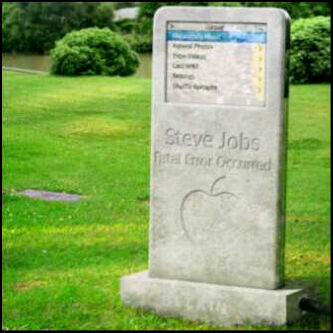
The man who brought the Mac computer, iPod, iPhone and iPad to the world, is also leaving a fashion legacy, with sales of his signature black mock turtleneck spiking in the days since his death from cancer on Wednesday at age 56
Tag Archives: steve jobs
Image
6
Oct

iCame iSaw iPod iPad iPhone iMac iCloud iRuled iQuit iDepart•?
RIP Steve Jobs O:)
Share this:
- Share on X (Opens in new window) X
- Share on Facebook (Opens in new window) Facebook
- Share on Reddit (Opens in new window) Reddit
- Share on LinkedIn (Opens in new window) LinkedIn
- Share on Tumblr (Opens in new window) Tumblr
- Email a link to a friend (Opens in new window) Email
- Print (Opens in new window) Print
- Share on Pinterest (Opens in new window) Pinterest
- Share on Pocket (Opens in new window) Pocket
Tags: departed r.i.p., icloud, imac, ipad, iphone, ipod, mac, steve jobs
- Comments Leave a Comment
- Categories Uncategorized
clouded reality
Join 459 other subscribers
Top Posts & Pages
- Old to the new….…
- Some Uber Drivers Strike To Protest Company’s Fare Cuts « CBS New York
- Facebook’s payment network is its largest source of revenue after advertising. Primarily through selling credits for virtual goods for use in social games like Farmville, Facebook earned $557 million last year through its payments network. What’s most surprising to a cynic like me is how honestly Facebook accounts for revenues from the payment network. There’s no accounting trickery going on in that $557 million figure. Payment networks provide easy opportunities for abuse, especially when they are configured like Facebook’s. On Facebook, users purchase credits that can later be redeemed for virtual goods, like a cow in Farmville. This creates the opportunity to book revenues from the initial purchase—even though much of the initial purchase price will later have to be handed over to the merchant of the virtual goods. Groupon was doing something like this. If it sold a $50 coupon for $100 of services, it booked the entire $50 as revenue—even though it would have to remit much of that to the merchant actually providing the goods and services. I’m not an expert in accounting rules but that strikes me as at least a bit questionable. Groupon was able to count the entire purchase price of the coupon as revenue because it considered itself the “primary obligor” in the coupon purchases. This struck me—and many others—as a bit of a stretch. Weren’t the companies that provided the services the primary obligors?